
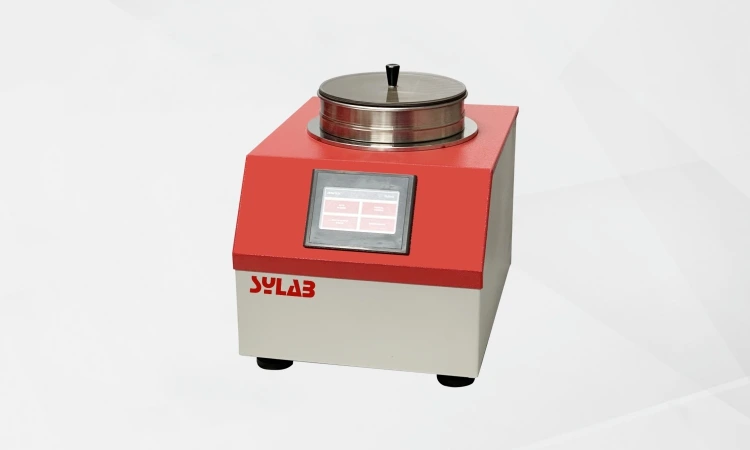
What Is an Air Jet Sieve Shaker?
Air Jet Sieve Shakers are an important part of modern sample preparation equipment used for precise particle size analysis in analytical laboratories. An Air Jet Sieve Shaker is a precision laboratory instrument designed for fine powder separation and particle size analysis, particularly for materials smaller than 100 microns.
Instead of vibration or mechanical motion, this device uses a stream of air and vacuum suction to separate particles by size. This makes it ideal for light, dry, or electrostatically charged powders such as flour, talc, cement, silica, and pharmaceutical ingredients.
The process is automated, clean, and highly efficient, ensuring rapid, repeatable, and accurate results with minimal sample loss.
Working Principle of an Air Jet Sieve Shaker
- Setup
- A single test sieve is placed horizontally in the shaker chamber.
- A powder sample (typically 5–100 g) is added.
- A vacuum system connects to the bottom of the sieve holder.
- Air Flow Generation
- When activated, the vacuum creates a strong downward airflow through the mesh.
- A rotating nozzle arm inside the chamber directs an air jet tangentially along the sieve surface.
- Particle Separation
- The air jet lifts, disperses, and deagglomerates the powder.
- Fine particles pass through the mesh and are collected by the vacuum.
- Coarser particles remain on the sieve for weighing and analysis.
- Analysis
- The difference in mass before and after sieving indicates the percentage of particles below a given size.
- Advanced models feature digital weighing and software integration for automatic data reporting.
Key Components
- Test Sieve: Typically, 200 mm (8 inches) in diameter, available in various mesh sizes.
- Vacuum Pump: Generates the suction necessary for airflow.
- Rotating Nozzle Arm: Rotates under the sieve to direct air and break up agglomerates.
- Control Unit: Adjusts test duration, vacuum intensity, and nozzle speed.
- Collection Receptacle: Captures fine particles passing through the sieve.
Advantages of Air Jet Sieve Shakers
- Ideal for Fine Powders: Perfect for particles < 100 μm (talc, silica, cement, flour, etc.).
- Non-Mechanical Action: Gentle air jet prevents particle breakage or agglomeration.
- Fast & Accurate: Delivers consistent, repeatable analysis in minutes.
- Clean Separation: Airflow minimizes mesh clogging and ensures complete sieving.
- Minimal Sample Loss: Efficient collection reduces waste and contamination risk.
- Easy Maintenance: Only one sieve used per test—simple to clean and sanitize.
Applications of Air Jet Sieving
- Pharmaceuticals: Ensures consistent API particle size and flowability.
- Cement & Building Materials: Monitors powder fineness for strength and quality.
- Chemicals: Classifies catalysts, pigments, and synthetic powders.
- Food Processing: Analyzes flours, spices, and powdered additives.
- Cosmetics: Guarantees uniformity of fine powders used in skincare and makeup.
Conclusion
An Air Jet Sieve Shaker offers a clean, fast, and precise method for particle size testing-ideal for industries where powder uniformity is critical. With automated air-based separation, minimal handling, and high repeatability, it provides superior performance for fine powder analysis compared to traditional vibration-based methods.
