
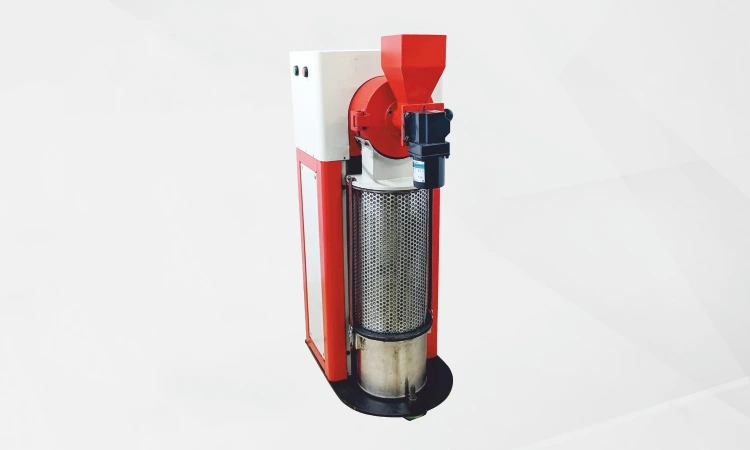
What Is a Hammer Mill?
A hammer mill is a powerful size reduction machine used to crush, pulverize, and grind materials into smaller, uniform particles. It operates using rapidly rotating hammers or blades that impact the material, breaking it down into fine pieces.
Renowned for its simplicity, versatility, and efficiency, the hammer mill is a go-to equipment in industries such as pharmaceuticals, agriculture, chemicals, food processing, mining, and recycling.
It handles a wide range of materials - from hard and fibrous to soft and slightly damp-making it one of the most adaptable grinding solutions.
How Does a Hammer Mill Work?
In many sample preparation workflows, a laboratory jaw crusher is used for primary size reduction before the material is further processed in a hammer mill.
At its core, a hammer mill relies on high-speed impact and controlled screening to achieve size reduction.
- Feeding
- Material enters the grinding chamber through a feeding hopper or conveyor. The feed is guided into the impact zone, where the hammers begin their work.
- Grinding Action
- Inside the chamber, hardened steel hammers mounted on a rotating rotor shaft spin at high speed.
- As they strike the material, they crush and shatter it into smaller particles through repeated impacts.
- Size Reduction & Discharge
- The ground material passes through a perforated screen or sieve.
- Particles smaller than the screen openings are discharged, while larger pieces are retained for further grinding until the desired size is achieved.
- This process ensures a consistent and uniform particle size distribution ideal for downstream processing.
Key Components of a Hammer Mill
- Feeding Hopper: Guides material into the chamber.
- Rotor Shaft: Central rotating component that holds the hammers.
- Hammers or Blades: Perform the impact grinding action.
- Grinding Chamber: Encloses the rotor and directs airflow.
- Screen or Sieve: Determines final particle size.
- Discharge Outlet: Releases the processed material.
- Motor / Drive System: Provides rotational power to the rotor.
Types of Hammer Mills
Depending on design and discharge method, hammer mills come in several types:
- Gravity Discharge Hammer Mills
- Use gravity to discharge material.
- Best suited for medium to coarse grinding.
- Pneumatic Discharge Hammer Mills
- Use air flow to assist discharge.
- Ideal for fine or heat-sensitive materials.
- Full Circle Screen Hammer Mills
- Feature 360° screen coverage for higher throughput and uniform grinding.
- Laboratory Hammer Mills
- Compact units designed for R&D and sample preparation.
Applications of Hammer Mills
For applications requiring ultra-fine particle sizes after coarse grinding, a planetary ball mill can be used as the next stage of the sample preparation process.
Hammer mills serve as critical size-reduction tools across multiple sectors:
- Agriculture: Grinding grains, corn, and livestock feed.
- Pharmaceuticals: Pulverizing active ingredients or excipients.
- Chemicals: Crushing and blending chemical compounds.
- Food Processing: Milling sugar, spices, herbs, and dried vegetables.
- Biomass & Recycling: Shredding wood, paper, plastics, and waste materials.
Benefits of Using a Hammer Mill
- Versatility: Handles a wide range of materials-hard, soft, or fibrous.
- Uniform Particle Size: Achieves consistent output for reliable quality.
- High Throughput: Efficient grinding for large-volume processing.
- Adjustable Output: Change screens to control particle size easily.
- Low Maintenance: Simple design ensures minimal downtime.
- Compact Design: Available in both industrial and laboratory versions.
Maintenance Tips for Hammer Mill Users
Regular care extends performance and lifespan:
- Replace worn hammers and screens promptly to maintain efficiency.
- Lubricate bearings and moving parts as per the manufacturer's schedule.
- Clean the grinding chamber after each use to prevent buildup.
- Check rotor alignment to reduce vibration and wear.
- Inspect the drive belts and motor regularly for smooth operation.
Conclusion
A hammer mill remains one of the most effective and reliable machines for size reduction.
Its robust design, flexibility, and consistent output make it indispensable across manufacturing, research, and production environments.
Whether for grains, chemicals, or recycled materials, hammer mills deliver power, precision, and performance in one compact package.
