
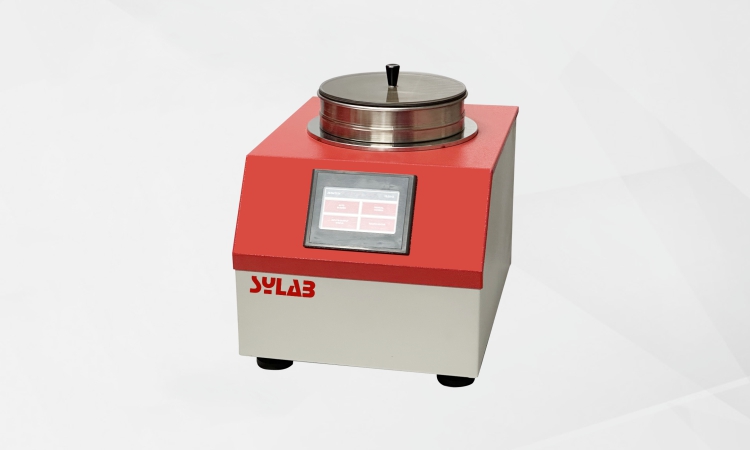
What Is an Air Jet Sieve Shaker and How Does It Work
In industries where fine powder separation is crucial, the Air Jet Sieve Shaker has become a preferred instrument for accurate and repeatable particle size analysis. Especially effective for particles smaller than 100 microns, this system is widely used in pharmaceuticals, chemicals, food, construction materials, and many other sectors.
An Air Jet Sieve Shaker is a smart lab device that gently sorts fine powders by size using a steady flow of air, making the process clean and precise. Instead of relying on vibration or mechanical motion, it employs air pressure and vacuum suction to pass particles through the sieve mesh, making it ideal for handling light, dry, or electrostatically charged materials.
The process is automated, clean, and highly efficient, reducing analysis time while increasing accuracy and repeatability.
Working Principle of an Air Jet Sieve Shaker
Here’s a step-by-step breakdown of how the machine operates:
1. Setup
- A single test sieve is placed horizontally in the shaker's chamber.
- A powder sample (usually 5–100 grams) is loaded into the sieve.
- A vacuum system is attached to the bottom of the sieve holder.
2. Air Flow Generation
- When the unit is activated, a vacuum creates a strong downward airflow through the sieve mesh.
- Simultaneously, a rotating nozzle arm inside the chamber directs an air jet tangentially along the sieve mesh.
3. Particle Separation
- The jet of air lifts and disperses fine particles in the sample.
- Particles small enough to pass through the mesh are sucked out and collected in the vacuum.
- Larger particles remain on the mesh, which are later weighed to calculate the particle size distribution.
4. Analysis
- By measuring the difference in mass before and after sieving, you can determine the amount of material below a specific size.
- Some advanced models also include digital weighing and software integration for automatic reporting.
Key Components of an Air Jet Sieve Shaker
- Test Sieve: Usually a 200 mm or 8-inch diameter sieve with varying mesh sizes.
- Vacuum Pump: Creates the suction required for air flow.
- Rotating Nozzle Arm: Rotates beneath the sieve to direct air flow and break up agglomerates.
- Control Unit: Lets you set parameters like test time, vacuum strength, and nozzle speed.
- Collection Receptacle: Catches the fine particles that pass through.
Advantages of Air Jet Sieve Shakers
- Ideal for Fine Powders: Efficient for particles <100 microns, including talc, cement, silica, flour, and pharmaceutical powders.
- Non-mechanical Action: Reduces the risk of agglomeration or mechanical damage to fragile particles.
- Fast and Accurate: Analysis can be completed in minutes with consistent, reproducible results.
- Clean Separation: Air flow prevents mesh clogging and ensures clean particle separation.
- Minimal Sample Loss: Fine particles are collected efficiently, reducing waste.
- Easy Cleaning: Since only one sieve is used at a time, the equipment is easy to maintain and sanitize.
Applications of Air Jet Sieving
- Pharmaceuticals: Particle size consistency in active pharmaceutical ingredients (APIs).
- Cement & Building Materials: Monitoring powder fineness for product quality.
- Chemical Industry: Classification of catalysts, pigments, and synthetic powders.
- Food Processing: Analysis of powdered spices, flours, and additives.
- Cosmetics: Ensuring uniformity in fine powders used in skincare and makeup products.