
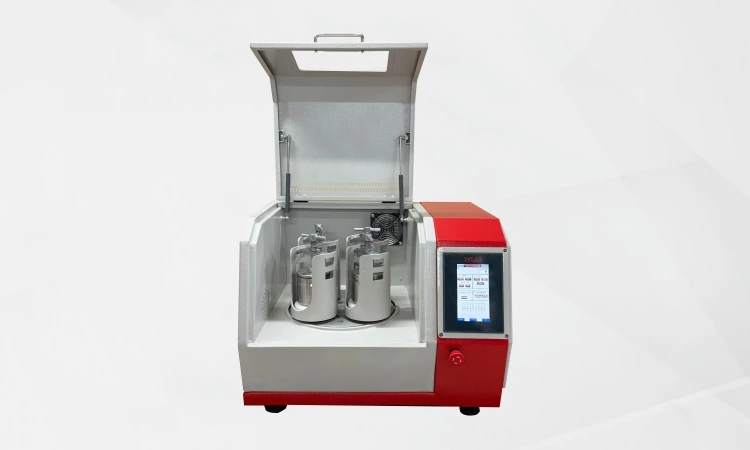
What is a Planetary Ball Mill?
A Planetary Ball Mill is a high-energy milling device used for grinding, mixing, and homogenizing materials at the micro- and nano-scale. It operates on the principle of planetary motion, generating strong centrifugal forces that break down materials with remarkable precision.
Compact yet powerful, it is a vital tool in industries like metallurgy, materials science, electronics, ceramics, pharmaceuticals, geology, and chemistry.
Planetary ball mills are ideal for:
- Fine grinding of hard and brittle materials
- Producing nanopowders and colloidal suspensions
- Mechanical alloying and reactive milling
Working Principle of a Planetary Ball Mill
The name "planetary" comes from the machine's motion-mimicking the way planets orbit the sun.
Step-by-Step Process:
- Rotational Motion:
The main sun wheel spins in one direction, while multiple grinding jars attached to it rotate around their own axes in the opposite direction.
- Centrifugal Force:
This dual motion creates powerful centrifugal and impact forces, causing the grinding balls to collide intensely with the material.
- High-Energy Impact:
These repeated collisions lead to rapid size reduction, intense mixing, and uniform particle dispersion-achieving nano-level fineness within minutes.
- Uniform Grinding:
The process ensures a homogeneous output with precise control over size, distribution, and consistency.
Key Components of a Planetary Ball Mill
- Main Sun Wheel: Drives the planetary motion of jars.
- Grinding Jars: Made from stainless steel, tungsten carbide, zirconia, or agate.
- Grinding Balls: Selected based on sample hardness and compatibility.
- Control Panel: Allows users to adjust speed, direction, time, and safety settings.
Applications of Planetary Ball Mills
Planetary ball mills are versatile tools in scientific and industrial research:
- Material Science: Nano-particle production, alloy synthesis, and mechanical activation.
- Pharmaceuticals: Mixing, homogenizing, and grinding active ingredients.
- Metallurgy: Fine powder preparation and sintering material processing.
- Ceramics: Grinding ceramic compounds and glazes for uniform texture.
- Geology & Mining: Pulverizing rocks, ores, and mineral samples.
- Environmental Science: Grinding soil or plant matter for chemical and elemental testing.
Benefits of Using a Planetary Ball Mill
- Ultra-Fine Grinding: Achieves nano-level particle sizes (<100 nm).
- High Efficiency: Strong impact and friction ensure quick processing.
- Versatile Compatibility: Handles soft, hard, brittle, and fibrous materials.
- Contamination Control: Choose non-reactive jar materials (e.g., zirconia, agate) for clean results.
- Programmable Operation: Control speed, duration, and direction for optimal performance.
- Compact Design: Space-saving, low-noise, and user-friendly.
Choosing the Right Planetary Ball Mill
When selecting a planetary ball mill for your lab:
- Grinding Stations: Choose single or multi-station models based on sample volume.
- Jar & Ball Material: Match materials to prevent contamination.
- Speed & Time Control: Ensure programmable and reverse motion capabilities.
- Ball-to-Powder Ratio: Maintain an ideal ratio (commonly 10:1) for consistent results.
Best Practices for Effective Milling
- Clean jars and balls before and after each use.
- Avoid overfilling-maintain optimal load and ratio.
- Use appropriate ball size for desired fineness.
- Monitor temperature-pause if overheating occurs.
- Always wear PPE and follow lab safety guidelines.
Conclusion
The Planetary Ball Mill stands as a cornerstone in modern material processing and research-offering precision, control, and versatility in one compact design. Whether you're developing nanomaterials, homogenizing pharmaceuticals, or preparing geological samples, this tool ensures uniform, contamination-free, and reproducible results every time.
