
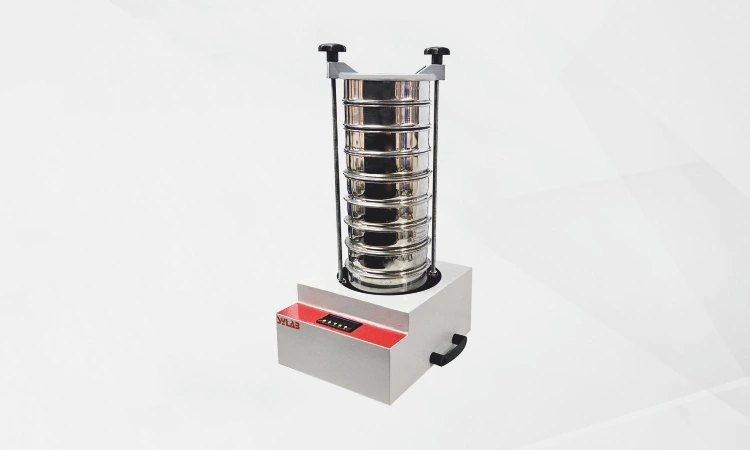
A vibratory sieve shaker is a precision instrument used in laboratories and industries to separate and classify particles by size through controlled mechanical vibrations. It's the modern, automated alternative to manual sieving-offering higher accuracy, consistency, and efficiency for materials like powders, minerals, aggregates, food ingredients, and pharmaceuticals.
At its core, the shaker holds a stack of sieves with decreasing mesh sizes. When switched on, the system vibrates the entire stack, causing the material to move and stratify. Finer particles pass through, while larger ones remain on top-achieving precise, repeatable particle size separation.
- Sieve Stack: Series of sieves arranged from largest to smallest mesh size.
- Vibratory Motor / Electromagnetic Drive: Produces consistent multi-directional vibrations.
- Control Panel: Adjusts vibration intensity, frequency, and test duration.
The main goal of a vibratory sieve shaker is to provide accurate, repeatable particle size analysis for quality control, R&D, and production testing.
- Precise Particle Size Distribution: Identifies accurate size range for better process control.
- Repeatability & Accuracy: Automated vibrations reduce human error.
- Time & Labor Efficiency: Processes multiple samples faster than manual methods.
- Standards Compliance: Meets global testing norms like ASTM, ISO, and BS.
- Enhanced Product Quality: Ensures uniform texture, strength, and performance.
- Versatile Applications: Ideal for powders, soils, granules, aggregates, and food materials.
| Aspect | Vibratory Sieve Shaker | Manual Sieving |
| Operation | Automated vibration | Hand shaking |
| Consistency | Uniform and repeatable | Operator dependent |
| Speed | Fast and efficient | Time-consuming |
| Accuracy | High precision | Often inconsistent |
| Fatigue | Minimal | Physically demanding |
| Compliance | Meets ISO/ASTM | Harder to standardize |
Automated vibratory shakers deliver faster, more reliable, and standardized results, making them the preferred choice for modern laboratories.
How Does a Vibratory Sieve Shaker Work?
The working principle is simple yet highly effective. The device vibrates a stack of sieves, separating materials according to particle size.
Step-by-Step Process:
- Load the Sample - Place material in the top sieve (largest mesh).
- Clamp the Stack - Secure sieves for stable operation.
- Set Parameters - Adjust vibration amplitude and duration.
- Start the Vibration - Electromagnetic motion drives the sieving process.
- Separation - Finer particles pass downward; larger ones stay above.
Types of Vibratory Motion
- Vertical Motion: Up-and-down vibration for strong separation.
- 3D Motion: Circular + vertical movement for maximum efficiency.
- Horizontal Motion: Gentle movement, ideal for delicate materials.
Key Advantages of Vibratory Sieving
- Highly accurate, repeatable results
- Rapid, automated operation
- Easy compliance with global standards
- Works across diverse materials and industries
Applications
- Pharmaceuticals: Uniform granule sizing for formulation.
- Construction: Testing sand, cement, and aggregates.
- Food Processing: Sorting grains, powders, and spices.
- Mining & Minerals: Classifying ores and raw materials.
- Chemicals: Ensuring consistency in powder production.
Conclusion
A vibratory sieve shaker is a must-have for industries that rely on precise particle size control. With automation, repeatability, and compliance, it outperforms manual sieving-ensuring accuracy, efficiency, and consistent product quality every time.
